Independent project · model-behavior research
Study refusal as a behavior you can measure and intervene on.
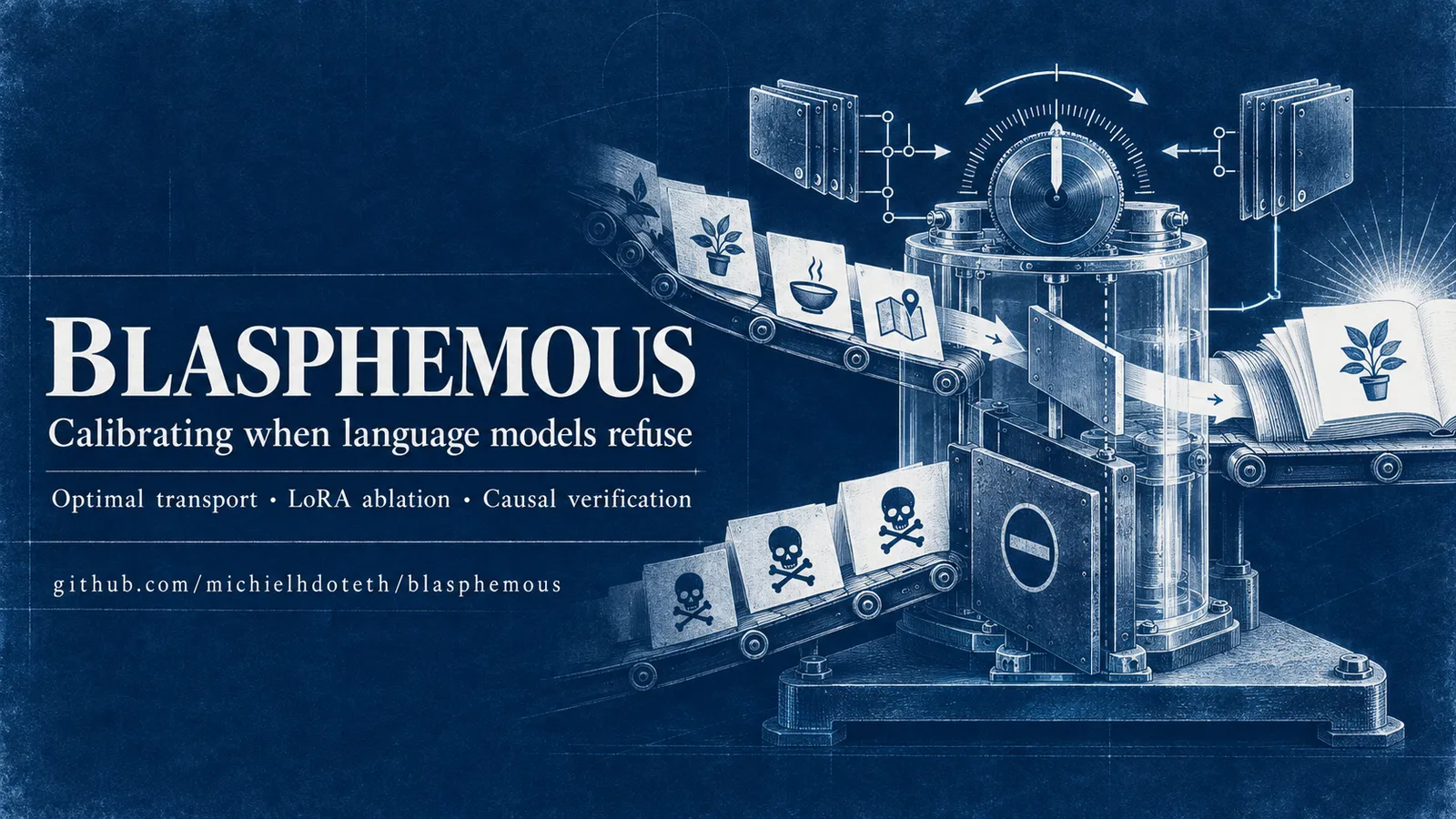
Blasphemous is a research toolkit for examining refusal-related representations in transformer activations and testing interventions against an evaluation suite.
THE QUESTION
The project asks where refusal-related directions appear in model activations, and what changes when an intervention is tested against a fixed set of prompts.
01 / WHAT IT DOES
The system
- Tools for analyzing refusal-related directions and activation geometry.
- Intervention paths that include projection and LoRA-based methods, with Bayesian search for tuning experiments.
- Evaluation that separates harmful-prompt refusal from harmless-prompt refusal and tracks distribution shift with KL divergence.
02 / ENGINEERING CHOICES
What shaped it
01
Measure both sides of refusal
The evaluation tracks refusal on harmful prompts alongside false refusal on harmless prompts, rather than optimizing one number in isolation.
02
Compare interventions under the same evaluation
Projection and LoRA approaches can be examined against shared prompt sets and scoring criteria.
03
Treat experimental methods as experimental
The repository labels optimal-transport intervention work as experimental and retains a projection fallback.
03 / SCOPE AND LIMITS
What this does not prove
- Results depend on the model, prompts, data, and scoring setup. They do not establish general safety or behavior across models.
- An improved score on a test suite is not proof that an intervention preserves every capability or generalizes to unseen prompts.